
Separate tools or an all-in-one platform: how to decide for your company

When to keep WhatsApp, spreadsheets, calendar and payments separate and when to move to an all-in-one platform with CRM, chat, payments and AI.
Monday, 9 a.m. A customer writes on WhatsApp asking about their order. The advisor looks up their name in the spreadsheet, checks the calendar to see whether they had an appointment, opens the payment gateway to confirm whether they paid and asks a colleague whether the invoice was already sent. Ten minutes later she replies. Nothing was misconfigured: each piece simply lives in a different place.
What is an all-in-one platform?
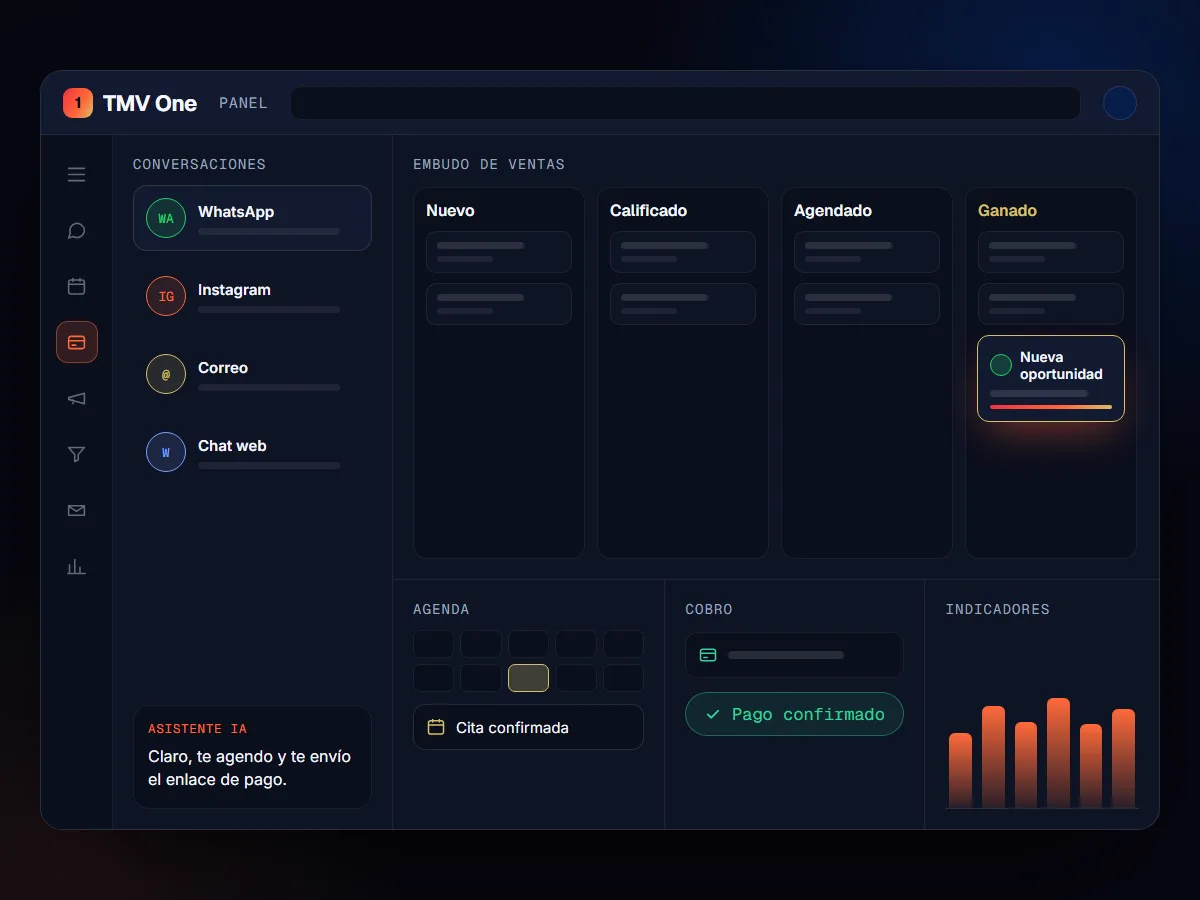
An all-in-one platform is a system where the CRM, conversations, calendar, payments and automations work on the same customer record. When someone writes, whoever answers sees on the same screen who they are, what stage they are in, whether they have an appointment and whether they already paid.
The difference from separate tools is not the number of features, but that data is not copied by hand from one place to another. If you want to review what a CRM does on its own, we explain it in what a CRM is and when your company needs one.
When do separate tools work?
Separate tools work well while volume is low and one person keeps everything in their head. At the start, WhatsApp Business on a phone, a spreadsheet and the phone’s calendar are enough and almost free.
The problem appears with growth: a second advisor joins, messages arrive on Instagram, you start charging by link and someone has to move data from one tool to another. Every manual copy is a chance for error and a delay for the customer.
What are the signs that you need to unify?
The clearest sign is that nobody can quickly answer what happened with a customer without opening several apps. Check whether any of this happens to you:
| Situation | With separate tools | With a unified platform |
|---|---|---|
| A customer asks about their order | You search chat, spreadsheet, calendar and gateway | Everything shows up in their record |
| An advisor goes on vacation | Their conversations stay on their phone | The history stays with the company |
| You want to know which campaign brought sales | Files have to be cross-checked | The source is recorded on each contact |
| A payment comes in | Someone announces it in an internal chat | The payment is recorded and triggers the next action |
| A lead does not reply | It depends on someone remembering | An automatic follow up picks it back up |
If you checked three or more, the cost of fragmentation is already higher than the cost of unifying.
Watch out: unifying does not mean buying the biggest platform. It means each customer’s data lives in one place and the tools you keep connect to that place, not the other way around.
What does data protection have to do with it?
In Colombia, Law 1581 of 2012 requires keeping consents and keeping data secure and up to date, and that is much easier with a single system. Article 17 of the law requires, among other duties, keeping a copy of the consent, storing information under security conditions that prevent its loss and updating it in a timely manner.
Something similar happens with WhatsApp: according to Meta’s opt-in policy, you can only write to a person if they gave you permission, and it must make your company’s name clear. If that consent is in a form, the contact on an advisor’s phone and the conversation somewhere else, proving it gets complicated. We expand on this in the guide on Law 1581 on WhatsApp and CRM.
What should the platform include?
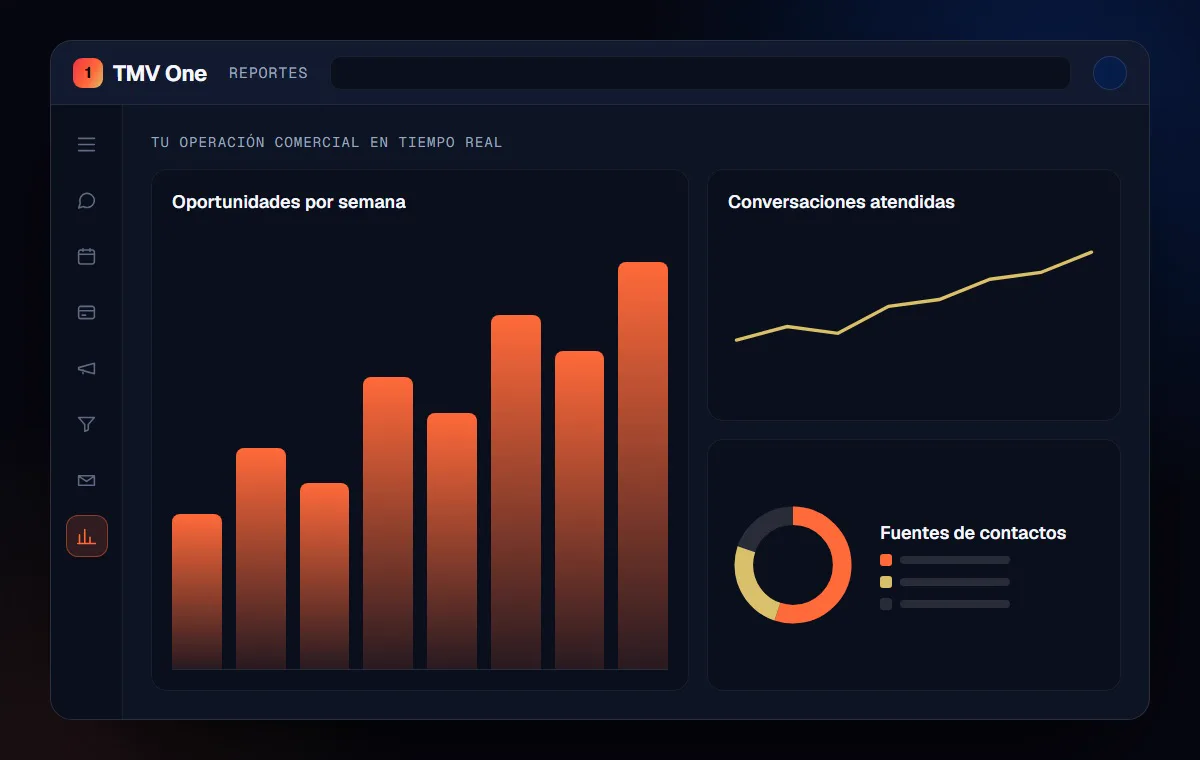
At a minimum: CRM with a pipeline, conversations inbox, calendar, payments, automations and reports, connected to each other. From there, each company adds what its process requires: email campaigns, bulk messaging, reviews, capture pages or an AI assistant.
Before choosing, keep three questions in mind:
- How does WhatsApp come in? For several people to handle the same number from one system, the official API is used. It is worth knowing how Meta charges: according to its pricing page, charges are per delivered message and depend on the category and the country. And since October 1, 2026, according to its documentation for service messages, replies inside the service window are also charged, as we explain in since October 2026 replies are charged too.
- What happens to your current data? Ask what can and cannot be migrated before signing.
- Who sets it up? An empty platform solves nothing. The value is in leaving the pipelines, messages and automations built around your operation.
If you are comparing CRM options, Zoho CRM or Kommo: which to choose will also help.
How do you switch without stopping operations?
The switch is done in stages: first the diagnosis, then setup, data migration, testing and training. What you should not do is shut everything down on a Friday and turn the new system on Monday. The healthy approach is to move one channel or team first, validate and then add the rest.
At tumarcaviral.com we built TMV One, our platform that brings together CRM, conversations, payments, calendar, automations and AI, and we implement it with each company according to its process.
In short
If your team has to open four apps to answer a simple question, the problem is not the people but the fragmentation. An all-in-one platform puts each customer in a single record, helps you comply with data protection and lets automations do the repetitive work.
Frequently asked questions
What is an all-in-one platform for businesses?
It is a system that brings together in one place the CRM, conversations from several channels, the calendar, payments, campaigns and automations, all connected to each customer’s record.
When does it make sense to stay with separate tools?
When volume is low, one person handles everything and you do not need to cross data between tools. If every sale goes through three apps and someone copies data by hand, it is time to unify.
Does an all-in-one platform replace all my tools?
Not always. Some specialized tools, such as electronic invoicing or an ERP, usually stay separate and connect through integrations.
What does Law 1581 have to do with this?
Article 17 requires whoever processes data to keep a copy of the consent, keep information secure and keep it up to date. With data spread across several tools, that is harder to do.
Do not stop at the theory: apply it to your business
We implement TMV One end to end, with your real operation. The first conversation is free.